
Table of Contents
- How Long Should a Room Smell Scented? The Honest Answer
- Noticeable Scent Duration vs. Product Lifespan
- How Long Do Room Fresheners Last?
- How Long Does a Reed Diffuser Last?
- Why Can't I Smell My Room Fragrance Anymore?
- How to Keep a Room Smelling Fresh
- Troubleshooting Weak or Short-Lived Scent
- Choosing a Composition for Your Room
- Frequently Asked Questions
Last Updated: October 25, 2026
How Long Should a Room Smell Scented? The Honest Answer
A room should smell scented for about 30 to 60 minutes after you actively scent it, with a faint background trace that lingers for a few hours in a closed space. That is the honest answer, and it is shorter than most product pages suggest.
Here is the part most guides get wrong: they treat "how long should a room smell scented" as a product spec. It is not. It is a perception question, and perception fades faster than wax or oil does.
Noticeable scent duration is how long a person can detect fragrance in a room. Product lifespan is how long the candle or diffuser physically keeps working. These are two different clocks, and confusing them is why people feel let down by products that are performing exactly as designed.
A candle might burn for many hours. A peer-reviewed review of habituation and adaptation to odors in humans is a useful starting point for understanding why your nose stops reporting a scent it is sitting in.
Noticeable Scent Duration vs. Product Lifespan
The gap between these two numbers explains most fragrance disappointment. Product lifespan is measurable: burn time, fill volume, how many weeks a diffuser keeps releasing. Noticeable duration is subjective and shifts with the room, the airflow, and the person doing the smelling.
Think of it as two separate questions:
- How long does the product keep working? Days, weeks, or hours, depending on the format.
- How long does a person notice it? Usually far less, because the nose tunes out steady background scent.
A reed diffuser can release fragrance for weeks. A guest walking in on day ten may still catch it. The person living in the room may have stopped registering it days earlier. Both are true at once.
For a fuller set of definitions on scent throw and diffusion, the glossary covers the terms this section keeps running into.
How Long Do Room Fresheners Last?
Room fresheners last anywhere from a few minutes to several weeks, depending on the format. Sprays are the shortest, candles sit in the middle, and diffusers run the longest. But the useful number is not how long the product keeps working, it is how long a person in the room keeps noticing it. Those are two different clocks, and the table below separates them. These ranges are practical estimates, not guarantees; room size, airflow, temperature, and product design change them.
Format | Noticeable scent (person in the room) | Product lifespan | Best for |
|---|---|---|---|
Room spray | 10-30 minutes | Until the bottle empties | Quick resets before guests |
Candle | 30-60 minutes while lit, plus a short tail after snuffing | Many hours of burn time | Evening atmosphere in one room |
Reed diffuser | A few hours of background trace per session; strongest in the first week or two | Weeks of continuous release | Steady, low-effort background scent |
Essential oil diffuser | 30-60 minutes of active mist | Refill dependent | Short, adjustable sessions |
Wax melt or plug-in | 1-3 hours of noticeable scent per session | Days to weeks per refill | Consistent low-level scent in small rooms |
Why the formats behave so differently
A spray delivers a concentrated burst of volatile compounds into the air all at once. Those compounds are small and light, so they disperse and dilute quickly, often within half an hour in a room with any air movement. That is why a spray feels strong for a minute and then seems to vanish.
A candle works the other way. Heat drives fragrance out of the wax pool steadily while the flame is lit, so scent accumulates in the room rather than flashing off.
A reed diffuser is the opposite of a burst: quiet, constant, and easy to stop noticing. The reeds wick oil upward and release it passively, which means output is low but continuous.
An essential oil diffuser sits between spray and candle. The mist is active while the unit runs, then stops when it does. Output is adjustable, which makes it useful for short sessions, but it does not build a lasting background the way a candle's residual scent does.
The number on the label is not the number you experience
Product lifespan, burn time, fill volume, weeks of diffuser release, is measurable and usually accurate. Noticeable scent duration is subjective and shifts with the room, the airflow, and the person doing the smelling. A candle rated for many hours of burn time is not claiming the room smells scented for all of them. Confusing the two is why people feel let down by products performing exactly as designed.
For a fuller set of definitions on scent throw and diffusion, the glossary covers the terms this section keeps running into.
How Long Does a Reed Diffuser Last?
A reed diffuser typically keeps releasing fragrance for several weeks, though the strength declines gradually rather than stopping on a set day. The reeds pull oil upward and release it into the air, and that process slows as the oil level drops. Flipping the reeds refreshes output for a while, but each flip spends oil faster.
Three things shorten a diffuser's useful life:
- Dry air and strong airflow pull the oil out faster.
- Warm rooms speed evaporation.
- Too few reeds mean less surface area and weaker release.
The trap is expecting constant strength for the whole run. Diffuser output is often strongest early, then gradually becomes background scent; timing varies with product design, room temperature, airflow, and reed count. That quieter presence is often exactly what people want in a hallway or bedroom.
Why Can't I Smell My Room Fragrance Anymore?
You likely cannot smell your room fragrance because of olfactory adaptation: your brain stops reporting a scent it has been exposed to continuously. This is normal and happens to almost everyone. The fragrance may still be present, but your response to it has decreased.
Olfactory Adaptation, Explained Simply
Your sense of smell is built to detect change, not constants. A new scent gets flagged. The same scent, hour after hour, gets tuned out so your brain can notice other things. This is why you stop smelling your own candle but a visitor comments on it the moment they walk in.
A quick test: step outside for five minutes, then come back in. If the scent is there on return, adaptation is the culprit, not a weak product. For a deeper look at the causes behind weak throw, see why candles smell like nothing and how to fix it.
How to Keep a Room Smelling Fresh
Keeping a room smelling fresh comes down to managing airflow, timing, and source placement rather than adding more fragrance. More product rarely fixes a scent problem caused by stale air. Better habits usually do.
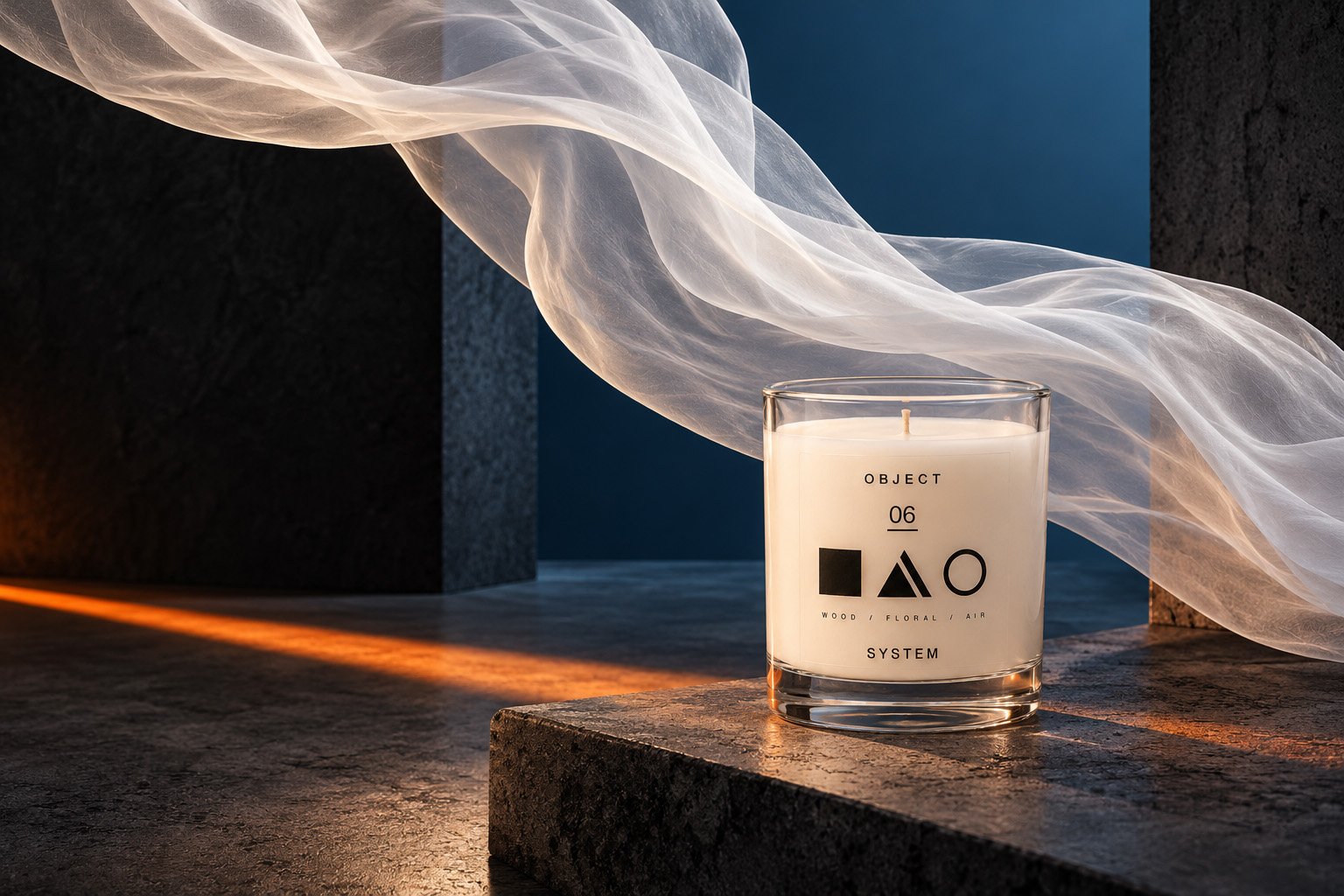
OBJECT / SYSTEM Composition 06 candle with sculptural airflow in an architectural setting
Start with these:
- Air the room first. Open windows for a few minutes to clear stale air before adding scent.
- Scent in short sessions. Run a candle or diffuser for a set window, then stop. Breaks reset your nose.
- Place the source near airflow, not in a corner. Moving air carries scent; still corners trap it.
- Match the format to the moment. Spray before guests, candle for evenings, diffuser for steady background.
- Deal with odor, don't mask it. Masking a source with fragrance usually reads as two smells fighting.
Room by Room and Ventilation
Small, closed rooms hold scent longer but also trigger adaptation faster. Large, open rooms dilute scent quickly and need more presence to register at all.
- Bedrooms: low, steady background works best; strong scent overnight can feel heavy.
- Living rooms: larger volume needs a more expansive presence or a longer session.
- Bathrooms: ventilation clears scent fast, so short bursts suit the space.
- Kitchens: cook odors need removal first, scent second.
If you want to think through room size and placement more precisely, you can use the presence guidance in the OBJECT / SYSTEM system and calculate your own room's dimensions.
Troubleshooting Weak or Short-Lived Scent
Weak scent usually traces back to one of four causes: a trimmed-too-short wick, a cold or drafty spot, a room too large for the format, or plain adaptation. Work through them in that order before assuming the product is faulty.
- Wick too short or trimmed wrong: the flame starves and throw drops. Trim to 1/4 inch before each burn.
- Draft or AC vent nearby: moving air scatters scent before it builds.
- Room too big for the format: a single small candle will not fill an open-plan space.
- Adaptation: step out and back in to check whether scent is actually present.
Watch out: trimming a wick too short is one of the most common reasons a candle suddenly stops throwing scent, and it is easy to do without noticing. For wick trimming, burn duration, placement, and stop-use guidance, the burn care guide walks through each step.
Choosing a Composition for Your Room
Choosing a fragrance for a room starts with two questions: how much presence you want, and what direction the scent should lean. Answer those before you shop, and the choice gets much simpler.
OBJECT / SYSTEM organizes its six candle compositions around three perceptual elements: WOOD, FLORAL, and AIR. Every composition uses exactly three symbols. Count them; do not read their sequence. Repetition describes perceived emphasis, not formula percentages. In Composition 04, for example, repeated AIR indicates greater perceived AIR emphasis while WOOD provides structure; sequence does not affect the reading. Presence is classed as INTIMATE, AMBIENT, or EXPANSIVE, which gives you a way to calibrate by room instead of guessing.
- INTIMATE suits smaller rooms and closer range.
- AMBIENT fits everyday living spaces.
- EXPANSIVE is built for larger volumes and more presence.
Presence describes the intended experience, not a guaranteed room size or a performance score. It is a starting point, not a promise. If you want to act on this section directly, you can choose a composition by presence, scent direction, and room.
Frequently Asked Questions
How long should a room smell scented after using a candle?
Expect the noticeable scent to linger for roughly 30 to 60 minutes after you extinguish a candle, sometimes longer in a small, closed room. That window is about how long the air holds fragrance, not how long the candle itself lasts. A candle can burn for many hours across many sessions while each individual burn only scents the room for that short stretch. If you want continuous scent, you need either a longer-burning session or a second method running alongside it.
Why does a room stop smelling scented after a while?
Two things happen. First, the fragrance disperses: airflow carries molecules out through doors, windows, and ventilation, and soft surfaces absorb some of them. Second, your nose adapts. With continuous exposure, your olfactory system can stop flagging the smell as new, so you notice it less even while fragrance remains in the room. This is why guests often smell a room more strongly than you do. A short break can help you reassess.
Does opening a window make a room's scent fade faster?
Yes. Fresh air dilutes and carries away fragrance molecules, so an open window will shorten how long a room smells scented. That is not always bad: ventilation clears stale air, cooking odors, and excess fragrance that has built up. Air the room first, then scent it with the windows closed, and crack a window briefly if the scent feels heavy. Rooms with good airflow simply need fragrance refreshed more often.
How can I keep a room smelling fresh without making the scent too strong?
Choose a lower-presence composition and use less of it. A single candle in an intimate or ambient presence, or a reed diffuser with fewer reeds, gives a background level of scent rather than a wall of fragrance. Scent one room at a time instead of every room at once, and let each space breathe between sessions. If you stop noticing it, resist the urge to add more immediately; leave the room for ten minutes and reassess before topping up.
The real challenge is not finding a stronger fragrance. It is matching presence to the room and giving your nose a break so it keeps noticing. OBJECT / SYSTEM approaches that through composition, proportion, and clearly defined presence levels, with material transparency behind every composition. Get started with OBJECT / SYSTEM and choose a composition calibrated to your space.
