

Last Updated: October 24, 2026
Quick Summary
Reading fragrance scent profiles means separating mood language from usable detail: check the scent direction in plain words, the presence the maker intends, and the room it suits. Fragrance families give general character, while notes describe perception over time, not a recipe or strength promise.
- Count the symbols; do not read their sequence. Repetition describes perceived emphasis, not formula percentages.
- Presence describes intended scent experience, not a guaranteed room size or performance score.
- Scent throw is how far scent travels; diffusion is how evenly it spreads.
- Airflow, ceiling height, open-plan layouts and warmth all change how a scent reads.
- Match presence to the room: INTIMATE is built to sit close, EXPANSIVE to carry.
Table of Contents
- Start With the Description, Not the Story
- Fragrance Families Explained: The Broad Categories
- How to Read Fragrance Notes Without Overreading Them
- Frequently Asked Questions
Start With the Description, Not the Story
Reading fragrance scent profiles starts with separating mood pitch from usable information about fragrance scent profiles.
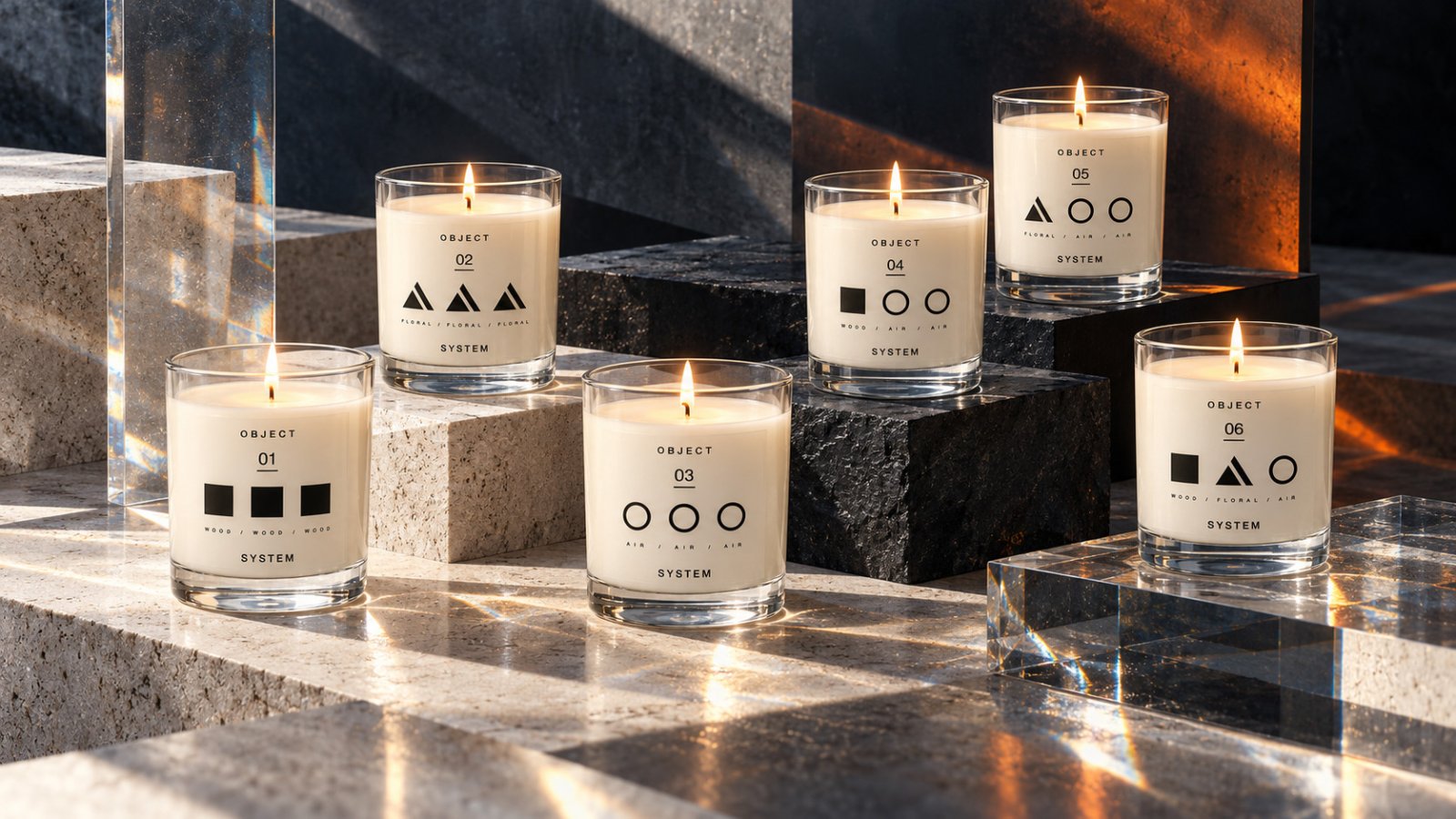
OBJECT / SYSTEM listings work this way: each composition carries a number and three element symbols describing scent character and relative emphasis, not ingredient percentages.
Ask three questions: what's the scent direction in plain words, how much presence does the maker intend, and what room is this for?
Infographic process for analyzing fragrance scent profiles by comparing candle notes at a desk
To apply this, start with the room and work backward from presence and scent direction.
Fragrance Families Explained: The Broad Categories
Fragrance families are broad groups describing how a scent reads: woody, floral, fresh or airy, and blends of those directions. They give general character, not strength or behavior in your space.
Two candles in the same family can read completely differently, the family is a starting point, not a verdict.
OBJECT / SYSTEM’s element system fills that gap. Every composition carries three symbols from WOOD, FLORAL and AIR. Count the symbols; do not read their sequence. Repetition describes perceived emphasis, not formula percentages: 01 reads WOOD / WOOD / WOOD at EXPANSIVE presence; 06 reads WOOD / FLORAL / AIR at AMBIENT presence.
To see the full set, compare all six compositions by scent, presence and room. For vocabulary, the three elements explained covers how WOOD, FLORAL and AIR combine.
How to Read Fragrance Notes Without Overreading Them
Fragrance notes describe how a scent is perceived over time, not a recipe. A note list is a reading guide, not a promise about strength.
Three terms trip people up: scent throw (how far scent travels), diffusion (how evenly it spreads), and presence (the intended scent experience). Presence describes intent, not a guaranteed room size or performance score. A candle marked INTIMATE is built to sit close; one marked EXPANSIVE is built to carry. Neither is better, they suit different rooms.
Room conditions matter just as much. Airflow, ceiling height, open-plan layouts and warmth all change how a scent reads. A candle that feels right in a small study may disappear in a double-height living room, physics, not a flaw.
Two things decide whether you like a candle: personal preference, which no system can predict, and performance, which a clear description can help you judge. Keep them separate and you'll make better choices.
If a term is still unclear, the glossary defines scent throw, diffusion and proportion. For presence in practice, presence in the room explains how room conditions affect it.
That's the method: read the description, place the family, check the presence, match it to the room. It won't tell you whether you love a scent, it will tell you whether the candle is likely to do what you want.
A few terms come up again and again when reading a scent profile, and each one means something specific.
Term | What it describes | Note |
|---|---|---|
Scent throw | How far scent travels | Not a strength promise |
Diffusion | How evenly it spreads | Separate from throw |
Presence | The intended scent experience | Describes intent, not room size |
INTIMATE | Built to sit close | Suits different rooms |
EXPANSIVE | Built to carry | Neither presence is better |
Frequently Asked Questions
How do you read a fragrance description?
Read it in layers. First find the fragrance family or scent direction, which tells you the broad character. Then look at the notes, which describe how that character is built. Finally check any stated presence or intensity, which hints at how much space the scent is meant to fill. A description that gives you all three is far more useful than one that only lists ingredients or tells a story. If a listing skips the family and presence entirely, treat the scent as a guess until you can smell it.
What is the difference between a fragrance family and a scent note?
A fragrance family is the broad category a scent belongs to, such as wood, floral or air. A scent note is a single descriptive element inside that family, like cedar or bergamot. Families help you narrow a large catalog quickly; notes help you fine-tune between two options in the same family. When you read fragrance scent profiles, use the family to decide whether a candle is even in your range, then use the notes to pick between close candidates.
How does room size affect how a candle smells?
Room volume, ceiling height, openness, airflow, and placement all affect how a candle is perceived. A larger, taller, or more open room can make the same composition feel less concentrated, while placing it near the part of the room you use may make it more noticeable. Use the presence label—INTIMATE, AMBIENT, or EXPANSIVE—as a starting point, not a guaranteed performance score, exact distance, or coverage claim.
Choosing scent online is a reading exercise, not a guessing game. OBJECT / SYSTEM organizes six candle compositions by WOOD, FLORAL and AIR, with defined presence levels from INTIMATE to EXPANSIVE, so you can narrow the field before anything ships. Each listing shows visible proportions and material descriptions rather than an invented story. Find your composition and choose by scent direction, presence and room instead of hope.
