

Table of Contents
- Why Do My Candles Smell Like Nothing? Start With the Timing
- Fragrance Load, Wax Compatibility, and the Safety Limits
- The Right Temperature and Mixing Method for Fragrance Oil
- Candle Scent Throw: How Wax Type and Curing Time Shape It
- Candle Wick Size and Scent Throw: The Melt Pool Test
- How to Make a Candle Smell Stronger: A Controlled Testing Protocol
- Candle Nose Blindness and the Room Setup That Undermines Scent
- When Not to Troubleshoot: Candles That Should Be Replaced
- Frequently Asked Questions
Last Updated: October 21, 2026
Why Do My Candles Smell Like Nothing? Start With the Timing
When candles smell like nothing, it usually points to a timing problem, not a fragrance problem: the scent is trapped in the wax, burned off too fast, or never released. At OBJECT / SYSTEM, compositions are built around visible proportions and defined scent presence, so every diagnosis starts with one question: when did the scent disappear?
That question splits the problem in two. Never strong, even unlit? The issue is wax, fragrance load, or cure. Fine for a week, then faded?
Below: a diagnostic flow, the safety limits that matter, and the fixes worth testing.
Candle scent throw is the distance and strength at which a candle releases fragrance into a room. Makers split it into two types, and knowing which one is missing changes the fix.
Cold Throw vs. Hot Throw: Which One Is Missing
Cold throw is the scent you notice before lighting the candle. Hot throw is the scent released while it burns.
Smell the unlit candle, then light it, leave the room for ten minutes, and compare.
- Weak cold throw, weak hot throw: the fragrance load is too low, the oil is poor quality, or the candle never cured.
- Strong cold throw, weak hot throw: a wick or burn problem. The wax isn't melting wide enough to release oil.
- Strong cold throw, strong hot throw at first, then fading: nose blindness or a room setup issue.
A Step-by-Step Diagnostic Flow
Work through these steps in order. Stop at the first one that fails.
- Smell the cold candle. No scent at all? Skip to fragrance load and cure.
- Check the wax surface. Cracks, sweat beads, or oil pooling on top mean the fragrance didn't bind.
- Light it for one hour. If the melt pool tunnels straight down the middle, the wick is too small.
- Leave the room for ten minutes. If the scent appears now, your nose had adapted while you sat beside it.
- Note the room. A drafty, large, or high-ceiling room reads as weak even when the candle performs well in a small bathroom.
- Check age and storage. Old candles and ones stored near heat lose top notes first.
Fragrance Load, Wax Compatibility, and the Safety Limits
Fragrance load is the percentage of fragrance oil by weight in the finished wax. Most makers work in roughly 6% to 10%, and many waxes cap out around 10% before the oil seeps or clogs the wick. Those numbers are starting points, not targets: the right load depends on the wax, fragrance, and wick you pair.
How to Calculate Fragrance Load by Wax Weight
The order matters: fragrance load is calculated against the weight of the wax, not the finished candle. Weigh the wax first, then multiply.
- 8% load on 450 grams of wax: 450 × 0.08 = 36 grams of fragrance oil.
- 6% load on 450 grams of wax: 450 × 0.06 = 27 grams of fragrance oil.
- 10% load on 450 grams of wax: 450 × 0.10 = 45 grams of fragrance oil.
Weigh in grams, never volume: fragrance oils vary in density. A scale reading to 0.1 gram removes the guesswork. In ounces, 16 ounces of wax at 8% is 16 × 0.08 = 1.28 ounces of fragrance oil.
Why More Oil Can Mean Less Scent
Past the wax's limit, adding fragrance backfires. The excess oil doesn't bind into the wax; it pools, seeps, or gets pulled into the wick, clogging the capillaries that feed the flame. The flame weakens, the melt pool shrinks, and the candle throws less scent than at a lower load. A maker chasing a weak candle from 8% to 12% often finds it smells weaker and burns worse.
Wax and Fragrance Compatibility
Wax compatibility matters as much as the number. Some oils are formulated for soy, some for paraffin, some for blends, and an oil that performs in paraffin can disappear in soy at the same percentage. Before a full batch, run a small test:
- Check the supplier's guidance. Most list a recommended wax and a maximum load for each oil.
- Pour a 4-ounce test candle at your planned load in your planned wax.
- Cure it for the full window your wax recommends, then burn it for one hour per inch of container diameter.
- Rate the throw on a 1-to-5 scale at ten minutes, one hour, and three hours.
If the test candle reads weak at a load the supplier lists as suitable, the wick or cure is more likely the problem than the oil. If the oil separates, beads on top, or smells burnt, the oil and wax are a poor match.
Safety Limits That Are Not Optional
- Never exceed the fragrance load your wax manufacturer lists, typically around 10% for container candles.
- More oil does not mean more scent. Past the wax's limit, the wick struggles and throw drops.
- Fragrance oils are flammable. Never add oil to wax that is already over its flash point, and never pour fragrance into a pot directly over an open flame.
The Right Temperature and Mixing Method for Fragrance Oil
Fragrance binds to wax best when the wax is warm enough to accept it and cool enough not to burn it off. Most waxes call for adding fragrance between 79°C and 85°C (about 175°F to 185°F). Follow your wax supplier's number, not a generic one.
Why Temperature Matters
Fragrance oils are volatile: top notes evaporate at lower temperatures than base notes. Add fragrance to wax that's too hot and those top notes flash off before the candle sets, leaving it flat and thin. If the wax is too cool, the oil doesn't fully incorporate and beads up as the wax sets. Both failures smell the same: a candle that smells like nothing.
The Mixing Method
Stir, don't swirl. Pour the oil into the melted wax and stir gently for about two minutes; a slow, steady stir folds the oil through without whipping in air bubbles, which trap oil and weaken the final scent.
- Add fragrance at the wax's stated temperature.
- Stir for a full two minutes, scraping the sides and bottom of the pot so no oil clings to the vessel.
- Pour at the temperature your wax recommends, often around 60°C to 65°C (140°F to 150°F).
How to Tell If the Oil Incorporated
Watch the cooling stage. A well-mixed candle sets with a smooth, even surface. These signs mean the oil didn't fully incorporate:
- Cloudy or streaky wax after it sets.
- Oil beads or a slick sheen on top of the wax.
- Wax pulling away from the glass as it cools, leaving a gap at the edge.
If you see these signs, the batch will likely throw weak. Note the temperature you used and adjust on the next pour.
Pouring and Cooling
Pour temperature affects appearance and scent. Too hot: the wax shrinks unevenly and pulls away from the container, creating air gaps that weaken throw. Too cool: a lumpy top and trapped air pockets.
Cool slowly and evenly. A drafty room or cold counter sets the wax unevenly, cracking the surface and losing scent at the edges. Covering the candle loosely while it sets slows cooling and gives a smoother top.
Candle Scent Throw: How Wax Type and Curing Time Shape It
Wax type sets the ceiling on scent throw. Soy wax burns clean and slow but often throws less intensely than paraffin. Paraffin wax throws strongly and reliably but splits opinion on air quality. Coconut wax and coconut-soy blends sit in between.
Curing time is the quiet variable: it lets fragrance fully bind to the wax before burning. Many makers cure soy one to two weeks and paraffin a few days.
If you make candles at home, label the pour date on the bottom. Burn one at day one, day seven, and day fourteen. The difference will tell you your wax's real cure window.
Candle Wick Size and Scent Throw: The Melt Pool Test
Wick size decides how much melted wax, and therefore fragrance, reaches the air. An undersized wick tunnels and starves the scent; an oversized one burns hot, scorches the oil, and can smoke.
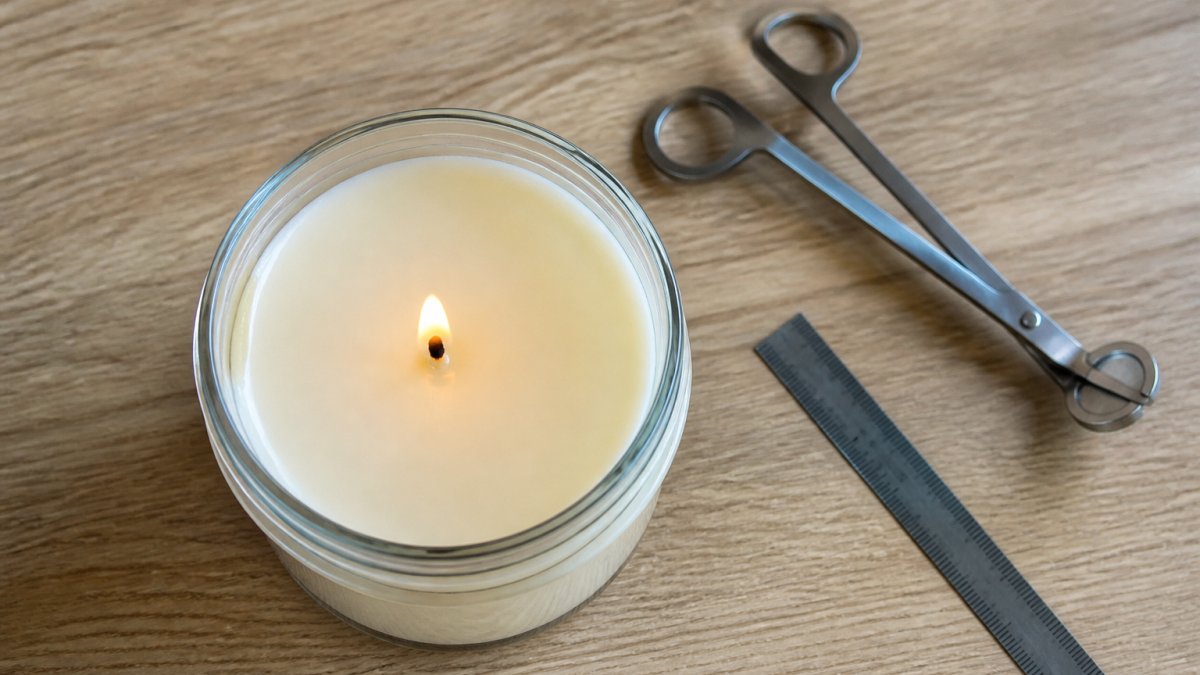
- Melt pool stops short of the edge: wick too small. Size up one step.
- Melt pool races to the edge in under 30 minutes, flame tall and flickering: wick too large. Size down.
- Melt pool even, flame steady, scent present: the wick is right.
Wick type matters too. Cotton wicks suit most fragrances. Wood wicks crackle and throw well but need careful trimming. Keep wicks trimmed to about 5 mm (¼ inch) before every burn.
How to Make a Candle Smell Stronger: A Controlled Testing Protocol
Changing five variables at once tells you nothing. Test one at a time and record the result.
Here's the protocol we'd use:
| Test | What to Change | How to Measure | What It Tells You |
|---|---|---|---|
| Burn test | Nothing, just burn | Scent at 10 min, 1 hr, 3 hr | Baseline hot throw |
| Cure test | Wait 7 more days | Smell at day 7 and 14 | Whether cure is the issue |
| Load test | Raise load 1-2 points, within wax limit | Compare throw at same burn time | Whether load was too low |
| Wick test | Size up or down one step | Melt pool width at 1 hour | Whether wick is the bottleneck |
| Room test | Move to a smaller room | Scent at 3 m (10 ft) | Whether the room is the problem |
Run one row per week, keeping the same fragrance, wax, and container so the comparison holds, and record the room, temperature, and burn time each session. It's slow by design, but it's the only way to know which fix actually worked.
Candle Nose Blindness and the Room Setup That Undermines Scent
Candle nose blindness is your brain tuning out a constant scent after repeated exposure. It's not a defect; it's how smell works. The ten-minute exit test is the simplest check. Room setup causes the rest of the "weak candle" complaints:
- Room too large: a candle sized for a bathroom will vanish in an open-plan living space.
- Drafts: air movement carries scent away before it builds. Keep candles away from vents, windows, and doorways.
- High ceilings: scent rises and disperses. More candles or a stronger presence level helps.
Rotating between two or three scents through the week resets nose blindness, so each reads stronger when you return to it.
When Not to Troubleshoot: Candles That Should Be Replaced
Some candles are past saving. Skip the fixes and replace them when you see these signs:
- The wax has pulled away from the glass and the scent is gone. The fragrance has already migrated or evaporated.
- The candle is years old and stored in heat. Top notes fade first, and no cure or wick change brings them back.
- The wick is buried or the wax is badly tunneled from earlier burns. The wax pool can't recover its shape.
For buyers rather than makers, the fix is choosing a candle with a stated scent presence and clear material description.
Weak scent is almost always a timing, load, or wick problem, and each one has a test you can run this week. Start with the ten-minute exit test, then work through the diagnostic flow before you change a single variable.
Frequently Asked Questions
Why does my candle smell strong unlit but not when burning?
That gap is cold throw versus hot throw. Cold throw is what you smell before lighting; hot throw is what the wax releases once melted. A strong cold throw with a weak hot throw usually points to a fragrance load near the low end for that wax, a wick too small to build a full melt pool, or too little curing time. Check the melt pool first: if wax clings to the jar wall after two hours, the wick is underpowered and the fragrance never gets hot enough to disperse.
Does candle wick size affect scent throw?
Yes, directly. The wick controls melt pool size, and melt pool size controls how much fragrance oil reaches the air. An undersized wick leaves wax unmelted at the edges, so a smaller surface releases less scent. An oversized wick burns too hot, which can scorch the fragrance and shorten burn time. The target is a full melt pool reaching the jar edge within about two hours of burning. Test one wick size up and one down before changing anything else.
Can you become nose-blind to a candle?
Yes. Candle nose blindness is olfactory fatigue: sustained exposure to the same molecules dulls your receptors, so a candle that filled the room on day one seems to fade by week two. The scent has not changed. Step out of the room for 15 to 20 minutes, then return, or ask someone else to confirm. Rotating between two or three compositions and burning in shorter sessions keeps your nose responsive.
Does room size affect how strongly a candle smells?
Room volume and airflow matter as much as the candle. A large open-plan space dilutes scent faster than a closed bedroom, and drafts from vents, fans, or open windows carry fragrance away before it accumulates. Close doors, shut off ceiling fans, and keep the candle away from air registers. In a big room, burn two candles of the same composition at opposite ends rather than one oversized candle in a corner.