
Last Updated: October 23, 2026
A Scent Classification System for the Home
Most home fragrance is described through notes.
Cedar. Jasmine. Citrus. Linen.
Useful, but incomplete.
A note can tell you what a fragrance resembles. It does not necessarily tell you how it is structured, how strongly one direction leads, or how the scent is likely to register in a room.
OBJECT / SYSTEM uses a different framework.
Three elements.
Six compositions.
Three levels of presence.
The point is not to make scent more complicated. It is to make it easier to read.
THREE ELEMENTS
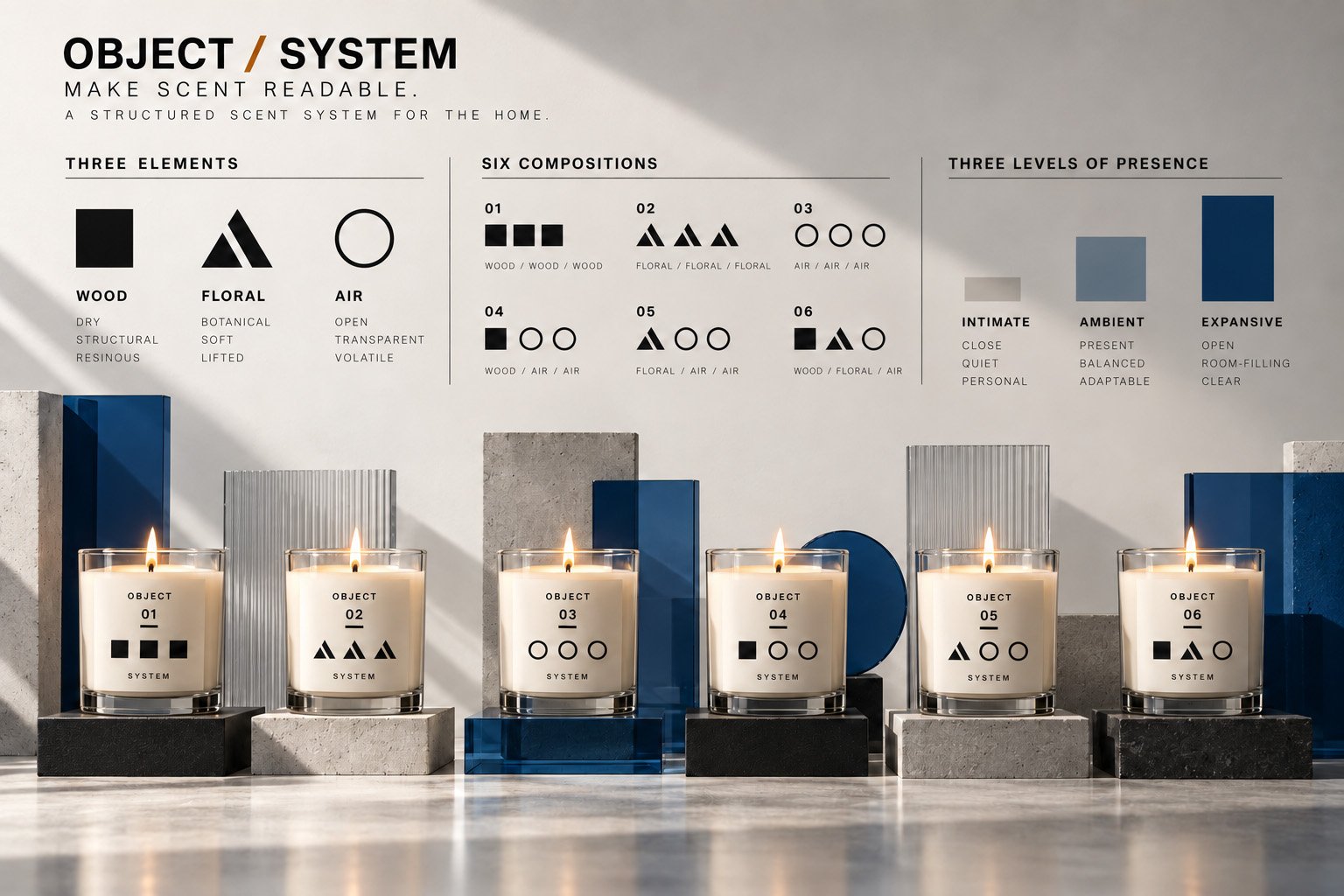
Every composition is described through WOOD, FLORAL and AIR.
WOOD
Dry. Structural. Resinous.
FLORAL
Botanical. Soft. Lifted.
AIR
Open. Transparent. Volatile.
These are perceptual categories, not literal ingredient lists.
WOOD can recall cedar, dry timber or sandalwood.
FLORAL can recall jasmine, green stem or soft petal.
AIR can recall linen, bergamot, clean air or open space.
The element tells you the direction.
The composition tells you the relationship.
READ THE SYMBOLS
Every OBJECT / SYSTEM composition contains exactly three symbols.
01
WOOD / WOOD / WOOD
02
FLORAL / FLORAL / FLORAL
03
AIR / AIR / AIR
04
WOOD / AIR / AIR
05
FLORAL / AIR / AIR
06
WOOD / FLORAL / AIR
Repetition shows perceived emphasis.
It does not show formula percentages.
Three WOOD symbols make 01 a pure WOOD composition. One WOOD symbol with two AIR symbols makes 04 a mixed composition where AIR carries more perceived emphasis while WOOD gives it structure.
The label becomes a way to read the scent before smelling it.
PRESENCE IS SEPARATE
Direction and presence answer different questions.
Direction: What kind of scent is it?
Presence: How does it occupy the room?
OBJECT / SYSTEM uses three relative levels.
INTIMATE
Most noticeable near the candle or within a smaller zone.
AMBIENT
A steady presence through a typical room.
EXPANSIVE
Designed to register across larger or more open space.
Presence is not a quality score.
More presence does not mean a better candle.
Room volume, airflow, ceiling height, placement and burn conditions all affect how fragrance is perceived.
That is why choosing only by scent preference can miss part of the decision.
START WITH THE ROOM
Instead of asking only, “What fragrance do I like?” start with the room.
How large is it?
How present should the scent feel?
Where will the candle sit?
Then choose a direction.
A bedside or desk may call for something that stays relatively close.
A living room may suit a steadier background presence.
A large open space may need something broader.
After presence, choose the scent direction: WOOD, FLORAL or AIR.
The system narrows from space to scent rather than the other way around.
SIX COMPOSITIONS
The six compositions create six different positions inside the same system.
01 / WOOD / WOOD / WOOD
Pure WOOD. Expansive.
02 / FLORAL / FLORAL / FLORAL
Pure FLORAL. Expansive.
03 / AIR / AIR / AIR
Pure AIR. Ambient.
04 / WOOD / AIR / AIR
WOOD structured by a larger AIR presence. Intimate.
05 / FLORAL / AIR / AIR
FLORAL with more AIR. Ambient.
06 / WOOD / FLORAL / AIR
All three elements held together. Ambient.
The numbers are not rankings.
They are names.
Notice the symbols. Call it by number.
WHY CLASSIFY SCENT THIS WAY?
Traditional fragrance families are useful for describing resemblance.
A structural system adds another layer.
It lets you separate:
- what the fragrance resembles
- which direction leads
- how the elements relate
- how present the scent is intended to feel
- where it may make sense in the home
That makes comparison easier.
01 and 04 both contain WOOD, but they do not read the same way.
02 and 05 both contain FLORAL, but AIR changes the structure.
03 and 06 can both sit at an AMBIENT presence while expressing completely different scent directions.
The classification gives those differences a language.
SCENT AS PART OF THE ROOM
Home fragrance occupies space.
That makes placement part of the experience.
A scent that feels balanced in one room may register differently in another. An open living area, a bedside and a bathroom do not ask the same thing from fragrance.
The goal is not to fill every part of the home with scent.
It is to choose the right structure for the space in front of you.
Start with the room.
Read the elements.
Choose the presence.
Then find the composition.
Find Your Composition
