

Last Updated: October 25, 2026
Quick Summary
Candles with no names are identified by a number and three symbols drawn from a fixed vocabulary of WOOD, FLORAL and AIR, so the label describes scent character rather than a story. Count the symbols; do not read their sequence. Repetition describes perceived emphasis, not formula percentages. Then check the separate presence classification.
- Each composition carries exactly three element symbols describing perceived scent character and relative emphasis.
- Repetition signals emphasis: three WOOD symbols point to a composition built entirely around that direction.
- Presence is a separate axis describing intended scent experience, not a guaranteed room size or performance score.
- Symbols communicate character, not strength, so do not read three symbols as three times anything.
- Start with one composition and assess it in your room before expanding.
Table of Contents
- Why OBJECT / SYSTEM Candles Have No Names, Just Symbols
- How to Read Candle Scent Profile Symbols
- How to Choose a Scented Candle Without a Fragrance Name
- Frequently Asked Questions
Why OBJECT / SYSTEM Candles Have No Names, Just Symbols
Most scented candles arrive with a name that does the work of a short story. OBJECT / SYSTEM takes a different approach: its candles with no names are identified by a number and three symbols drawn from WOOD, FLORAL and AIR. The label describes scent character rather than a narrative.
A name like “Cedar & Smoke” offers a sensory reference. A symbol set offers a consistent vocabulary for comparing compositions. Neither is an ingredient disclosure. The Federal Trade Commission’s guidance on advertising claims emphasizes truthful, non-misleading descriptions. A consistent vocabulary is useful only when its limits are clear.
How to Read Candle Scent Profile Symbols
Reading a scent profile symbol set takes three steps: identify the elements, count repetition without reading sequence, then check the presence classification. Each composition carries exactly three element symbols describing perceived scent character and relative emphasis, not ingredient percentages.
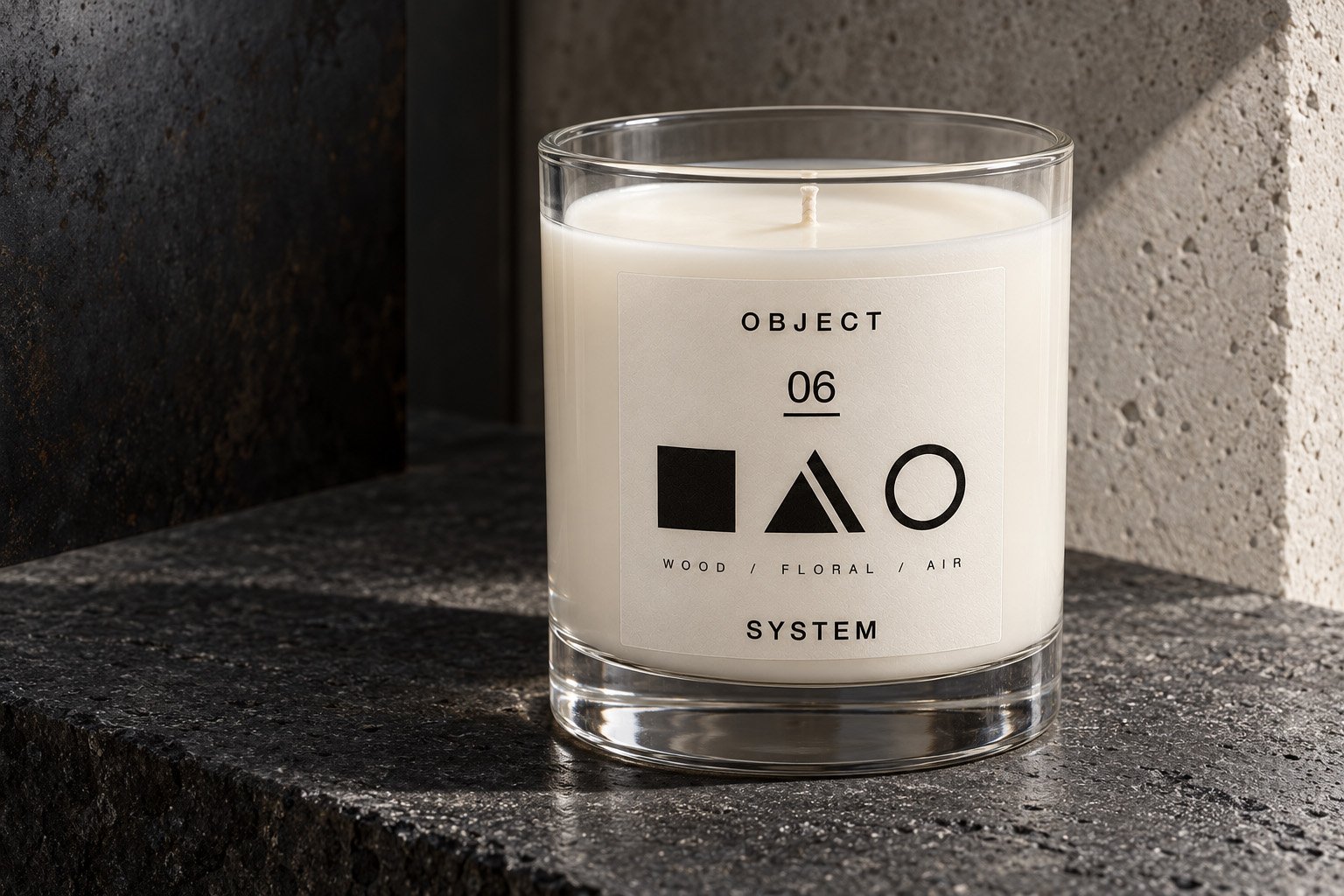
Close-up of OBJECT / SYSTEM 06 showing the WOOD, FLORAL and AIR symbols on its label.
The register is fixed, which is what makes it learnable:
Composition | Symbols | Presence |
|---|---|---|
01 | WOOD / WOOD / WOOD | EXPANSIVE |
02 | FLORAL / FLORAL / FLORAL | EXPANSIVE |
03 | AIR / AIR / AIR | AMBIENT |
04 | WOOD / AIR / AIR | INTIMATE |
05 | FLORAL / AIR / AIR | AMBIENT |
06 | WOOD / FLORAL / AIR | AMBIENT |
Repetition signals perceived emphasis: 01 has three WOOD symbols; 04 has one WOOD and two AIR symbols, so AIR has greater perceived emphasis while WOOD provides structure. Sequence does not change the reading. Presence is a separate axis describing intended scent experience, not a guaranteed room size or performance score. Treat INTIMATE, AMBIENT and EXPANSIVE as qualitative bands, not measurements.
Two cautions. First, symbols communicate character, not strength, so three symbols do not mean “three times” anything. Second, the National Candle Association explains candle safety labels, referencing ASTM F2058 for fire-safety labeling. Scent symbols do not replace those warnings or the manufacturer’s care instructions.
If a term like presence or perceived emphasis is unfamiliar, the glossary defines the vocabulary.
How to Choose a Scented Candle Without a Fragrance Name
Choosing without a name comes down to three questions: what the room is for, how much presence you want, and which direction you want to smell. Answer those in order and the register narrows itself.
Start with the room. A small study and an open living area may call for different levels of presence. No classification predicts the result precisely: room volume, airflow, ceiling height and placement all shift the experience. Use presence as a starting band, then adjust.
Fragrance notes and scent character describe different things. Notes offer sensory references; they are not necessarily a list of fragrance ingredients. Scent character describes how the composition reads as a whole.
A practical sequence:
- Name the room and roughly how large it feels
- Decide whether you want the scent to sit close or spread
- Pick a direction: WOOD, FLORAL, AIR, or a blend
- Match the symbol pattern and confirm presence fits the room
- Buy one, live with it, then expand
The last step matters. Live with one composition before expanding. If it feels too present, too faint or simply not right for the room, reconsider presence, placement and scent direction. Not noticing a familiar scent does not by itself establish a presence mismatch.
When you are ready to choose, start with the room to walk through presence, scent direction and a specific room in one pass. To compare all six, consider them by scent, presence and room.
The register makes comparison easier: six numbered compositions, exactly three element symbols each, and a separate presence classification. Compare the perceived elemental emphasis, then use INTIMATE, AMBIENT or EXPANSIVE as a relative room guide. The symbols do not disclose ingredient percentages. OBJECT / SYSTEM candles are made in Phoenix, Arizona.
Frequently Asked Questions
Why do some candles use symbols instead of fragrance names?
OBJECT / SYSTEM uses a consistent visual vocabulary so you can compare compositions without interpreting a different fragrance name each time. Every composition has a number and exactly three element marks drawn from WOOD, FLORAL and AIR. The symbols describe perceived scent character and emphasis, not ingredient percentages. Notice the symbols; use the number when asking for a composition.
What do the WOOD, FLORAL, and AIR symbols mean on OBJECT / SYSTEM candles?
WOOD describes dry, structural, resinous character. FLORAL describes botanical, petal and green-stem character. AIR describes open, transparent character. Count the symbols; do not read their sequence. Repetition describes perceived emphasis, not formula percentages. In 04, two AIR marks indicate greater perceived AIR emphasis while WOOD provides structure. In 06, all three elements have equal perceptual weight, not necessarily equal ingredient quantities. Presence is classified separately.
Do candle symbols show the exact ingredients or percentages?
No. They describe perceived scent character, not a recipe or ingredient disclosure. Three AIR marks do not mean 100% of one material, and a repeated element does not tell you fragrance strength. For material information, read the current product and materials pages. Use the symbols to compare scent character and the separate presence classification to guide room selection.
